Good Dog Academy
Student Handbook
Professional Dog Trainer Program
Canadian Standards Program

Welcome to Good Dog Academy
Welcome
At Good Dog Academy, our dedicated and experienced team is committed to supporting your success. We are here to guide, encourage, and assist you throughout your program experience.
Mission Statement
Good Dog Academy’s mission is to provide comprehensive, evidence-based, and up-to-date education for aspiring and existing dog industry professionals, as well as the general public, with the goal of raising standards in pet dog training, behaviour, and care.
GDA's Humane Training Model
At Good Dog Academy, humane training means more than simply being gentle. It reflects a commitment to compassion, safety, evidence-based training practices, and professional responsibility. We define humane training as kind, respectful, science-informed, and supportive of both the dog’s and human’s overall wellbeing.
Our Humane Training Model promotes a thoughtful and progressive approach to behaviour change through the use of positive reinforcement, careful observation, ongoing assessment, and collaboration with veterinary and behaviour professionals when appropriate.
Humane Training Model
-
Identify training goals and desired behaviours.
-
Develop a realistic training plan using Good Dog Academy’s Formula for Success and positive reinforcement principles.
-
Observe, document, and evaluate progress, including both successes and setbacks.
-
If progress stalls, assess and document possible contributing factors such as the environment, emotional state, learning history, physical health, or communication challenges.
-
Revise the training plan to better reflect the dog’s current needs, abilities, and emotional wellbeing.
-
Implement the updated training plan using humane, positive reinforcement-based methods.
-
If the dog continues to struggle, consult a qualified veterinarian to rule out pain, illness, or other underlying medical concerns that may be contributing to the behaviour.
-
If medical concerns have been ruled out and challenges persist, consult with a certified and experienced dog behaviour professional for additional guidance, collaboration, or a second opinion.
-
Adjust the training plan based on professional recommendations and continue monitoring progress.
-
If behavioural concerns remain unresolved, particularly those involving fear, anxiety, or aggression, referral to a board-certified veterinary behaviourist may be recommended for further evaluation and possible behaviour modification medication support.
-
If at any point the dog’s behaviour presents a safety risk to the guardian, other people, or other animals, immediate referral to a qualified professional experienced in aggression cases and risk assessment is strongly recommended.
Using This Handbook
The purpose of this handbook is to serve as a reference guide for students enrolled at Good Dog Academy. It contains important information about our programs, policies, procedures, and expectations to help support you throughout your learning journey. Please take the time to read this handbook carefully and refer back to it as needed during your studies.
This Student Handbook is searchable.
Enrollment & Participation Requirements
Application, Waiver, Release & Acknowledgement
Good Dog Academy’s Professional Dog Trainer BASIC and Professional Dog Trainer BUNDLE programs as well as our Canadian Standards Program, require you to fill in an application form, waiver, release and acknowledgement. Please click on the links above to preview the program specific forms.
Waiver Requirement: A completed waiver is mandatory for participation of these programs.
Payment Requirement: Graduation certificates will be issued only upon receipt of full payment.
School Policies
Code of Conduct
Good Dog Academy expects all students and graduates to uphold a professional and respectful Code of Conduct during and after their program of study. Failure to adhere to the Code of Conduct may result in immediate dismissal from the program without refund. In cases involving graduates, Good Dog Academy reserves the right to revoke certification when conduct is found to be in violation of these standards. Questions or requests for clarification may be directed to the Administration Team.
-
Students and graduates are expected to follow and uphold Good Dog Academy’s Humane Training Model.
-
Students and graduates must conduct themselves in a respectful and professional manner toward fellow students, staff members, clients, dogs, and Good Dog Academy Inc.
-
Harassment, bullying, intimidation, discrimination, slanderous remarks, or violent behaviour will not be tolerated in any form, whether online or in person.
-
Verbal abuse, threats, or aggressive behaviour of any kind toward students, staff members, clients, or members of the public will not be tolerated under any circumstances.
Admissions Policy
Good Dog Academy is committed to enrolling students who demonstrate a genuine interest in learning and who are likely to successfully achieve their educational and professional goals.
Privacy Policy
Under the Personal Information Protection Act (PIPA), students have the right to access their student file upon request. Personal information collected by Good Dog Academy is used solely for educational, administrative, and student support purposes and will never be sold, shared, or licensed to third parties.
Safety, Scope & Responsibility
Good Dog Academy trainers must always work within their professional scope and prioritize the emotional, physical and public safety of all involved. Humane training includes knowing when to refer out, when to pause and when to collaborate with veterinary and behavioural experts to support the dog’s full wellbeing.
We adhere to the Canadian Association of Professional Dog Trainers STOP List to ensure all practices are aligned with humane, ethical standards.
Employer-Sponsored Enrollment Policy
At Good Dog Academy, we recognize that some employers choose to invest in their employees’ professional development by sponsoring enrollment in the Professional Dog Trainer Certificate Program. While we value transparency with sponsoring employers, we are equally committed to protecting student privacy and confidentiality.
The following policy applies to employer-sponsored enrollments:
-
Program Progress Updates
Employers who have paid for an employee’s enrollment may request general progress updates at any time. These updates may include information such as program participation, completed modules, and overall progression through the coursework. -
Grades and Assessment Information
Specific grades, assignment feedback, quizzes, assessments, or other detailed performance evaluations will only be shared with the employer if the student provides explicit consent. Good Dog Academy will obtain confirmation from the student before releasing any grade-related information. -
Student Privacy and Confidentiality
Good Dog Academy is committed to maintaining the privacy and confidentiality of all student records. Unless written consent has been provided by the student, employers will only receive general information related to enrollment status, participation, and program completion.
This policy is intended to support a respectful balance between employer involvement and student privacy while fostering a positive and professional learning environment.
External Organizations Seeking Collaboration
Good Dog Academy welcomes partnerships and opportunities that support the education and professional growth of our students and graduates. This includes employment opportunities, mentorships, internships, volunteer placements, and collaborative partnerships.
All requests from external organizations must be submitted in writing to academy@gooddog.ca and include the organization’s name, website, contact information, a description of the opportunity, and an overview of the organization’s training philosophy and professional affiliations, where applicable.
Requests are reviewed by the Director of Training and/or Registrar to ensure alignment with Good Dog Academy’s humane, force-free, and evidence-based standards. Good Dog Academy reserves the right to decline any request that does not align with our mission, ethics, or professional standards.
Approved opportunities may be shared with students or graduates through official Good Dog Academy communication channels. Personal student information will never be shared without explicit consent.
Organizations interested in ongoing collaboration or partnership opportunities may be invited to enter into a formal partnership agreement. Any organization found to engage in unethical practices, aversive training methods, or misrepresentation of credentials may be removed from partnership listings or future collaboration opportunities.
Scope of Practice & Professional Expectations
Students and graduates of Good Dog Academy are expected to work within an ethical and professional scope of practice that prioritizes the welfare, safety, and wellbeing of both dogs and people. Graduates should represent their education, experience, and credentials honestly and avoid providing services beyond their level of competence or training.
Good Dog Academy promotes humane, evidence-based, and force-free training methods. Students and graduates are expected to apply these principles in their professional interactions, training practices, and public representation of the industry.
Dog trainers are not veterinarians, veterinary behaviourists, groomers, nutritionists, or legal professionals unless separately qualified and credentialed in those areas. Students and graduates are expected to recognize the limits of their expertise and refer clients to appropriate qualified professionals when medical, behavioural, nutritional, legal, or safety concerns fall outside their scope of practice.
Professional expectations include:
-
Treating clients, colleagues, students, staff, and dogs with respect and professionalism.
-
Maintaining honesty and integrity in marketing, communication, and representation of credentials.
-
Continuing to pursue professional development and evidence-based education.
-
Prioritizing safety and humane treatment in all training and handling practices.
-
Maintaining client confidentiality and professional boundaries.
-
Seeking guidance, mentorship, or referral support when working with complex or high-risk cases.
Failure to uphold these professional standards may result in disciplinary action, dismissal from a program, or revocation of certification.
Graduation Requirements
Theory courses and the Final Exam require a grade of 90% to pass.
Practical Skills Development assignments require a grade of 80% to pass.
CSP Practicum requires a grade of 80% to pass
Graduate with Honours
To be eligible for Honours Graduation, students must achieve a score of 100% on all quizzes and the Final Exam. A maximum of two attempts is permitted for each quiz and the Final Exam to achieve the required score.
If your records indicate that you have met the requirements for Honours Graduation, it is your responsibility to notify Good Dog Academy by emailing academy@gooddog.ca after successfully completing your Final Exam.
Graduation certificates will soon be issued automatically and Honours eligibility is not reviewed as part of the automated certificate process. All graduates will automatically receive a standard graduation certificate. Students who qualify for Honours Graduation must contact us to request an Honours review. If we do not receive your email, you may not receive your Honours Certificate and Honours Graduation Badge.
Once your eligibility has been verified, we will send you your Honours Certificate and Honours Graduation Badge, which you can proudly display on your website, social media, and other professional materials.
Complaints & Professional Conduct Review
Any person may submit a complaint regarding a Good Dog Academy Professional Dog Trainer Certificate or Canadian Standards Program Certificate holder who they believe is not acting in accordance with Good Dog Academy’s Code of Conduct or Humane Training Model.
All complaints are reviewed fairly and confidentially. Good Dog Academy may gather information from the complainant, the trainer involved, and any relevant witnesses or supporting documentation. The information will be reviewed by Good Dog Academy faculty to determine whether professional standards have been upheld.
Where appropriate, complaints may be resolved through clarification, education, or corrective guidance. If concerns are substantiated, disciplinary action may be taken, including warnings, additional educational requirements, suspension, or revocation of certification.
This process is intended to protect the integrity, professionalism, and humane standards of Good Dog Academy and its graduates.
Complaints or questions may be submitted to academy@gooddog.ca.
General Information
Program Access & Timelines
For seamless access to your program, students must register and participate using one consistent email address only.
Students must be 19 years of age or older to enroll in the Professional Dog Trainer Certificate (PDT) Program or the Canadian Standards Program (CSP). Successful completion of either program will result in the issuance of the applicable certificate.
Completion of all required registration paperwork, including the program application and waiver form, is required as part of enrollment.
Students are provided with one (1) full year to complete all program requirements. The average completion time for the PDT Program is approximately 28 weeks; however, timelines vary depending on each student’s schedule, availability, and pace of study. As the CSP Program is newer and more individualized in nature, completion timelines may vary between students.
Following graduation, students will continue to have access to their course materials for an additional one (1) year. During this period, lessons and resources may still be reviewed; however, assignment submissions, grading, practical reviews, and program updates are no longer included.
Practical Training Timeline
Both the PDT and CSP programs include practical training, video submission, and/or written assignment components. Students are strongly encouraged to begin working on these requirements well in advance of their completion deadline.
PDT students should allow a minimum of fourteen (14) weeks for practical training, video preparation, submission, and grading. CSP students should allow a minimum of six (6) weeks for practical submissions, written assignments, and review requirements. Delaying practical work may result in incomplete submissions before the program deadline.
Submission Guidelines - VERY IMPORTANT
To support a manageable and effective grading process, students may submit only one (1) video or written assignment per week. Students must wait to receive feedback on their submission before sending the next video or written assignment.
Good Dog Academy is unable to hold, queue, or pre-review multiple submissions at one time. Submitting work progressively and incorporating feedback as you move through the program is an important part of the learning process and helps ensure students receive the highest quality support and guidance possible.
Program Extensions
Under certain circumstances, students may apply for a one-time, three-month program extension. Extension requests must be submitted in writing to academy@gooddog.ca within thirty (30) days of the student’s original program deadline and are subject to approval by the Administration Team.
The cost of a program extension is $250 plus applicable taxes. Approved extensions allow students to continue from where they left off in their program.
Program Restarts
Students who require more time beyond the three-month extension period must re-register and restart their program. Restart requests must also be submitted in writing to academy@gooddog.ca within thirty (30) days of the student’s original program deadline. This policy is firm.
Students approved for a restart will receive a special coupon valued at $250 toward re-registration. Restarting a program provides a new one-year enrollment period; however, students must begin the program again from the beginning and complete all required coursework, quizzes, assignments, and assessments.
PDT students should note that Canine First Aid registration is included only once, either during the original enrollment or the restart, not both.
Tracking Your Training Experience
Students in both the PDT and CSP programs are strongly encouraged to maintain an ongoing training and experience log throughout their studies. Professional trainers benefit greatly from documenting their work, reflecting on outcomes, and identifying areas for improvement and growth.
Training logs may include practical program work, private lessons, group classes, shadowing opportunities, shelter or volunteer work, enrichment activities, cooperative care, behaviour modification, sports training, or any other hands-on learning experience involving dogs.
-
Your log should include important details such as:
-
Date, duration, and location
-
Dog information and training goals
-
Exercises, techniques, and reinforcers used
-
Behaviour and welfare observations
-
Adjustments made during training
-
Outcomes, follow-up plans, and personal reflections on what was learned and what could be improved next time
Students are encouraged to keep their records organized in one location, such as a notebook, spreadsheet, or app, and update them regularly. Maintaining thoughtful and accurate records is an important part of developing strong observation skills, ethical decision-making, and professional training practices.
Getting Started Successfully
Starting a new educational program can feel exciting, motivating, and sometimes overwhelming. Students who build strong habits early in their program are often more successful, more consistent, and feel more confident as they progress through their studies.
Recommended First Steps
When beginning your program, we recommend that you:
-
Read through the Student Handbook fully
-
Familiarize yourself with the course layout and lesson structure
-
Review program timelines and practical submission expectations
-
Create a dedicated notebook, spreadsheet, or digital folder for notes and training logs
-
Begin observing dogs and training interactions with a thoughtful and reflective mindset
-
Reach out for support early if you are feeling confused or stuck
Building Momentum Early
One of the most important predictors of success is consistent engagement from the beginning of the program. Students are encouraged to avoid long periods of inactivity and instead focus on steady, manageable progress each week.
Even short study sessions, training observations, note-taking, or hands-on practice can help build confidence and momentum over time. Progress is often easier to maintain than to restart after a long pause.
Creating a Training Schedule
Students are strongly encouraged to create a realistic weekly study and training schedule that fits their lifestyle, work commitments, and personal responsibilities. Setting aside consistent time each week for coursework, reading, practical training, and reflection can help prevent last-minute stress and improve long-term retention of the material.
Remember that dog training skills develop gradually through repetition, observation, reflection, and experience. Consistency is often more effective than intensity.
Illness, Injury, or Loss of a Demonstration Dog
If a student or their demonstration dog experiences a serious illness, injury, or medical condition during the program, students may request a temporary enrollment pause of up to six (6) weeks. This policy also applies in the unfortunate event of the loss of a demonstration dog.
Requests must be submitted in writing to academy@gooddog.ca and are subject to approval by the Administration Team. Supporting documentation may be requested depending on the circumstances. This is intended as a one-time allowance to support students during significant and unexpected situations.
When You Don’t Have a Dog
Students do not need to own a dog to begin the PDT or CSP programs; however, access to at least one suitable dog will be required for practical training, observation, behaviour work, and/or video submission components. Students may work with more than one dog throughout their studies.
Possible ways to find a dog to work with include:
-
Family or friends’ dogs
-
Neighbours’ dogs
-
Dogs from workplaces such as daycare, grooming, boarding, or dog walking facilities
-
Shelter or rescue dogs
-
Referrals through veterinary clinics or pet stores
-
Community bulletin boards or local networking opportunities
If you are not living with the dog you are working with, it is important to plan for consistent access. Ideally, students should work with the dog several times per week on a regular basis to support relationship building, training progress, observation skills, and practical development.
When selecting a demonstration dog, consider the dog’s temperament, training history, behaviour, and suitability for your current skill level. It is also important to ensure the guardian is supportive, cooperative, and able to provide regular access to the dog throughout the program.
Tuition, Pricing & Payment Information
Tuition, Pricing & Payment Information
Current tuition and pricing information for all programs can be found on the applicable program pages:
• Professional Dog Trainer Certificate Program (PDT)
• Canadian Standards Program (CSP)
Good Dog Academy offers several payment options to help accommodate different financial situations. Regardless of the payment option selected, students receive immediate access to their program upon registration.
Full Pay
The Full Pay option allows students to pay the full tuition amount, including applicable taxes, at checkout in a single payment.
Payment Plans
Good Dog Academy offers a 5-month payment plan option for both the PDT and CSP programs. A small payment plan fee is included in the total tuition amount. Payments are processed automatically each month using the payment method provided at registration.
If a scheduled payment is declined or missed, program access will be temporarily paused until payment arrangements have been resolved.
Klarna Financing
Good Dog Academy also offers financing through Klarna for eligible PDT programs only. The CSP Program is not eligible for Klarna financing at this time.
-
Depending on the student’s credit profile, Klarna may offer payment terms ranging from approximately 6 to 24 months. Students selecting Klarna should be aware that:
-
A service fee is added to the tuition total to offset Klarna processing costs
-
Klarna determines all approval decisions, interest rates, and financing terms
-
Missed Klarna payments may affect your credit score
-
Good Dog Academy does not manage Klarna’s customer service, financing decisions, or repayment policies
Students are encouraged to carefully review all payment terms and select the option that best suits their financial situation.
Refunds
The refund period for the Professional Dog Trainer (PDT) and Canadian Standards Program (CSP) programs is seven (7) days from the date of registration. Refund requests must be submitted in writing to academy@gooddog.ca within this timeframe.
During the 7-day refund period, students will have access to the first two modules of their program only. Once the 7-day refund period has passed, full program access will be released automatically. Students who wish to have full access immediately may request early release of all program materials by emailing academy@gooddog.ca; however, doing so waives eligibility for a refund.
After the 7-day refund period:
-
Payment Plan payments are non-refundable. Students who choose not to continue must notify Good Dog Academy in writing, and future scheduled payments will be cancelled once notice is received.
-
Klarna-financed registrations are non-refundable after the 7-day refund period. Please note that Klarna financing is available for eligible PDT programs only.
If a scheduled payment is declined or missed for any reason, program access may be immediately deactivated until payment arrangements have been resolved. It is the student’s responsibility to contact Good Dog Academy and bring their account up to date.
Certificates will not be issued until all tuition payments and outstanding balances have been paid in full.
Student Support Learning Resources
Student Support & Learning Resources
At Good Dog Academy, we are committed to creating a supportive, engaging, and professional learning environment for all students. Our programs are designed not only to provide educational content, but also to help students feel guided, connected, and supported throughout their learning journey.
Both the PDT and CSP programs include a variety of student support and learning resources, including monitored lesson comments, student mentor support, webinars, and community discussion spaces. These resources are designed to help students strengthen their understanding of the material, receive guidance throughout the program, and continue developing their practical and professional skills.
Students are encouraged to actively participate, ask questions, seek clarification when needed, and make use of the support systems available to them. Learning to work with dogs is a progressive process that develops through education, observation, reflection, discussion, and hands-on experience.
Monthly Student Webinar
Good Dog Academy hosts a live Monthly Student Webinar for current students and graduates, typically held on the second Saturday of each month at 10:00 AM Pacific Time.
These webinars are an excellent opportunity to connect with the Good Dog Academy team and community in real time. Students are encouraged to attend regularly to ask questions, discuss program material, receive guidance, and participate in conversations about current and trending topics within the dog training industry.
Each webinar includes opportunities for open discussion, learning, and professional growth, and often features deeper conversations on important industry topics beyond the core program material.
We strongly encourage students and graduates to take advantage of this valuable opportunity for mentorship, continuing education, networking, and community support.
You will receive automatic registration for these webinars, with reminders and prompts to attend.
Coaching & Feedback
Good Dog Academy is committed to providing students with meaningful guidance, constructive and kind feedback, and professional support throughout their learning journey. Both the PDT and CSP programs include coaching and mentorship designed to help build confidence, strengthen practical skills, and deepen understanding of humane, evidence-based dog training.
Students receive detailed feedback on practical and written submissions to support continued growth and learning. Expectations for assignments and practical evaluations are clearly outlined within the programs, and grading criteria are provided to help students understand what is required for successful completion.
Tuition includes up to two (2) attempts per video submission or written assignment. Additional submission attempts may be permitted at a cost of $50 plus applicable taxes per submission.
Additional Coaching Options
One of the best places to ask questions, share observations, and participate in discussions is within the lesson comment sections throughout the programs. These comment areas are regularly monitored by the Good Dog Academy team, and many valuable discussions, clarifications, and learning opportunities happen there. Students are strongly encouraged to participate and engage with both mentors and peers through these discussions.
Students in both the PDT and CSP programs have access to mentor support throughout their studies.
Program mentors offer Zoom office hour appointments on Saturdays. Students wishing to attend must book their appointment with their program mentor by 5:00 PM Pacific Time on the Friday prior. Zoom access information is provided in the student Welcome materials.
Meet Cat, Your PDT Mentor
As your PDT Mentor, Cat is here to support you throughout your learning journey. A graduate of Good Dog Academy's Professional Dog Trainer Certificate program herself, she understands what it's like to work through new concepts, develop practical skills, and build confidence as a trainer.
Cat is known for her kindness, encouragement, and willingness to help students succeed. Whether you're looking for clarification on course material, guidance on assignments, or simply reassurance that you're on the right track, she's here to support you every step of the way.
For PDT Program Zoom office hour appointments, students may contact Cat at PDTMentor@gooddog.ca.
Meet Mair, Your CSP Mentor
Mair was the first graduate of Good Dog Academy's Canadian Standards Program and played an important role in helping refine and strengthen the program you are about to complete. Having worked through the curriculum herself, she understands both the challenges and rewards of advancing your knowledge and skills to meet Canada's national training standards.
As your CSP Mentor, Mair is here to support you throughout the practicum process by providing guidance, feedback, and encouragement as you apply your learning in real-world situations. Her firsthand experience with the program, combined with her commitment to helping others succeed, makes her a valuable resource as you continue your journey toward becoming a knowledgeable, ethical, and skilled professional dog trainer.
For CSP Program Zoom office hour appointments, students may contact Mair at CSPMentor@gooddog.ca.
Students are also encouraged to make use of the Community Portal and private student Facebook group to connect with peers, participate in discussions, share experiences, and continue learning collaboratively. Access to the private Facebook group is provided after registration. Helpful PDFs and downloadable learning resources are included throughout the programs, and students are encouraged to save these materials for future reference and study. Quick questions may also be directed to the team by email to academy@gooddog.ca.
Students seeking additional one-on-one coaching beyond the support included in their program may book private Zoom coaching sessions with Jaime Knowles at a discounted student rate of $85 plus applicable taxes per hour. To arrange additional coaching, students may contact academy@gooddog.ca.
Dogsafe® Canine First Aid
Dogsafe® Canine First Aid is included as part of the Professional Dog Trainer Certificate (PDT) Program. Students enrolled in the PDT Program will be required to complete a separate registration process for the Dogsafe® course. Once registered, the Canine First Aid program must be completed within two (2) months.
The Canadian Standards Program (CSP) does not include Dogsafe® Canine First Aid; however, CSP students may choose to add the certification for an additional fee.
The Dogsafe® Canine First Aid certification is valid for three (3) years, after which renewal is required by retaking the program. Future renewal fees and recertification costs are not included in program tuition.
PDT Support Program
At Good Dog Academy, we believe that learning and professional growth continue well beyond graduation. The PDT Support Program was created to help graduates stay connected, continue developing their skills, and remain current with program updates and evolving industry knowledge.
The PDT Support Program provides ongoing access to updated educational materials, mentorship, guidance, resources, and continued learning opportunities designed to support long-term success in the professional dog training industry.
PDT graduates are invited to subscribe to the Good Dog Academy PDT Support Program following graduation.
Master Guide to Submissions
Overview
Practical video and written assignments are an important part of both the PDT and CSP programs. These submissions are designed to help students develop practical skills, communication abilities, professional problem-solving skills, and the ability to apply humane, evidence-based training principles in real-life situations.
The PDT Program includes multiple practical video and written assignment components throughout the program. The CSP Program includes one written assignment and two video submissions.
All submissions are reviewed progressively with instructor feedback provided along the way. Students are expected to use feedback from each submission to improve future work and continue building their skills throughout the program.
Important Submission Policy
Students may submit only one (1) video or written assignment at a time and must wait to receive instructor feedback before submitting the next assignment.
This policy is extremely important and is designed to:
-
Support progressive learning and skill development
-
Allow students to apply feedback before moving forward
-
Maintain fair grading timelines for all students
-
Prevent grading backlogs and delays within the system
Good Dog Academy is unable to hold or queue multiple submissions from the same student at one time.
What We Look For
Submissions should demonstrate:
-
Clear understanding of the exercise or assignment requirements
-
Humane, evidence-based training practices
-
Clear communication and instruction skills
-
Appropriate problem-solving and troubleshooting ability
-
Professionalism and thoughtful handling skills
-
Understanding of the dog’s welfare, behaviour, and emotional state
Students are encouraged to explain their thought process, training decisions, observations, and adjustments throughout their work whenever appropriate.
Submission & Grading Policies
Please review the following important grading policies carefully:
-
Submissions are graded one day per week
-
Only one written assignment or video submission per student will be graded each week to ensure fair grading time for all students
-
Students are permitted two attempts per video or written assignment
-
If grading requirements are not met, students may be asked to re-record, revise, or resubmit their work
-
Additional submission attempts beyond the included two attempts are subject to additional grading fees of $50 plus applicable taxes per submission
Deadline Considerations
Students are strongly encouraged not to wait until the final weeks of their program to begin practical submissions. Practical training, recording, grading, revisions, and resubmissions can take significant time.
Please note:
-
Submissions requiring resubmission within two (2) weeks of the program deadline may be subject to additional grading fees
-
Students submitting required assignments within thirty (30) days of their program deadline may be required to purchase a program extension if additional grading or reassessment time is needed to complete graduation requirements
The programs are intentionally structured to provide students with adequate time to practice, build skills, complete assignments, and progress successfully through the submission process.
Video Recording Requirements
When recording video submissions, students should ensure that videos are clear, professional, and easy for instructors to review.
Please follow these guidelines:
-
Practice the exercise in your filming location before recording whenever possible
-
PDT videos must be a minimum of 3 minutes and a maximum of 15 minutes
-
CSP videos are a minimum of 45 minutes - no longer
-
Begin recordings by stating your name, your dog’s name, and the exercise or assignment being submitted
-
Your recording device must clearly capture both you and the dog at all times
-
Ensure good lighting and minimal background noise
-
If filming outdoors, be mindful of wind and environmental distractions
-
Test your audio and video quality before completing a full recording
-
Video editing is strictly prohibited
-
If possible, having another person record your session may improve video quality
Dropbox Video Submission Guide (PDT Program Only)
PDT students are required to use Dropbox for all practical video submissions. A free Dropbox account is sufficient and students should not need to purchase a paid Dropbox plan for program submissions.
Students may use an existing Dropbox account or create a free account by following the steps below.
Setting Up a Free Dropbox Account
-
Open your web browser and go to Dropbox.com
-
Click “Sign Up”
-
Enter your first name, last name, email address, and create a password
-
Agree to the Dropbox Terms
-
Click “Sign Up”
-
Verify your email address through the confirmation email sent by Dropbox
-
When selecting a plan, choose the Free Plan
If you experience technical issues with Dropbox, we recommend contacting Dropbox Support directly.
How to Upload Your Video Submissions (Desktop or Laptop Recommended)
-
Create a folder on your desktop labeled appropriately using your name and submission number
Example: Jane Smith – Submission #1
-
Open Dropbox
-
Drag and drop your folder into Dropbox
-
Once uploaded, click the “Share” button
-
Ensure the folder permissions are set to “Can Edit” for anyone with access
-
Add BOTH of the following email addresses:
-
Click the “Share Folder” button to complete the upload process
Uploading Using an iPad:
-
Open the Dropbox App and click the blue “+” button
-
Select “Create a Folder” and label it using your name and submission number
-
Select “Upload Photos” and upload your videos
-
Once the upload is complete, click “Share”
-
Select “Invite to Folder”
-
Add BOTH email addresses:
-
Click “Share Folder” to complete the process
Important Upload Tips:
-
Do not use your phone to upload videos whenever possible
-
The Kajabi mobile app does not work reliably with Dropbox uploads
-
Log into your program through GoodDog-Academy.com instead of the Kajabi app when working with submissions
-
Always label your folders and files clearly
-
Ensure videos are fully uploaded before closing Dropbox or shutting down your device
-
Keep a backup copy of your videos until grading has been completed
Google Drive Video Submission Guide (CSP Program Only)
CSP students are required to use Google Drive for practicum video submissions. Because CSP video submissions are significantly longer in length, Google Drive provides a more reliable system for uploading and sharing larger video files.
Students may use an existing Google account or create a free Google account if needed. A free Google Drive account is typically sufficient for CSP submissions.
Setting Up a Free Google Account & Google Drive
-
Open your web browser and go to Google Drive
-
Sign in using an existing Google account, or select “Create Account” if you need a new account
-
Follow the prompts to create your Google account
-
Once signed in, Google Drive will automatically be available to you
If you experience technical issues with Google Drive, we recommend contacting Google Support directly.
How to Upload Your CSP Video Submissions (Desktop or Laptop Recommended)
-
Create a folder on your desktop labeled appropriately using your name and submission number.
Example:Jane Smith – CSP Submission #1
-
Open Google Drive
-
Click “New” and select “Folder Upload”
-
Select your submission folder and upload it to Google Drive
-
Once uploaded, right-click the folder and select “Share”
-
Add BOTH of the following email addresses:
-
Change permissions to “Editor” access
-
Click “Send” or “Share” to complete the process
Uploading Using an iPad:
-
Open the Google Drive App
-
Tap the “+” button
-
Select “Upload”
-
Create or select your submission folder labeled with your name and submission number
-
Upload your video files
-
Once uploaded, tap the folder and select “Share”
-
Add BOTH email addresses:
-
Ensure permissions are set to “Editor” access
-
Tap “Send” or “Share” to complete the upload process
Important Upload Tips
-
Because CSP videos are lengthy, uploads may take significant time depending on your internet speed
-
Whenever possible, upload using a desktop or laptop computer instead of a phone
-
Avoid using the Kajabi mobile app for uploads
-
Log into your program through GoodDog-Academy.com - using a web browser instead
-
Clearly label all folders and video files
-
Ensure uploads are fully completed before closing Google Drive or shutting down your device
-
Keep backup copies of your videos until grading has been completed
-
Stable internet connections are strongly recommended for large video uploads
Technical Upload Guidelines
-
Always upload videos from a laptop or desktop computer rather than directly from a phone
-
Use lower-resolution recording settings whenever possible to reduce upload issues and file size
-
Do not record in HD, 4K, widescreen, or other high-resolution formats unless specifically instructed
-
Ensure your recording device has sufficient battery life and storage space before filming
-
All uploaded files must be clearly labeled using the required naming format
-
Example: Jane Smith – Basic Video #1 – Focus
Clear labeling is essential to help instructors locate and organize submissions efficiently.
Final Tips for Success
-
Start your practical work early
-
Practice before recording
-
Test your sound and camera positioning before filming
-
Read grading instructions carefully before submitting
-
Apply feedback thoughtfully before moving on to the next assignment
-
Remember that steady, progressive improvement is part of the learning process
Students who pace themselves consistently throughout the program generally experience the most success and the least stress near program deadlines.
Professional Dog Trainer Certificate Program (PDT)
Professional Dog Trainer Certificate (PDT) Program Overview
The Professional Dog Trainer Certificate (PDT) Program combines theory-based education, Dogsafe® Canine First Aid certification, and practical skills development to help students build professional knowledge, hands-on training ability, communication skills, and humane, evidence-based dog training practices for real-world application.
Theory
The Theory portion of the PDT Program consists of 23 educational modules covering dog training, behaviour, learning theory, welfare, handling skills, and professional development topics. Most of the content is presented in easy-to-read written lessons, with some supporting videos included throughout the program. The program is also proud to include presentations from several well-renowned expert guest speakers within the dog training industry. Students are strongly encouraged to take notes as they progress through the material. Helpful PDFs and downloadable resources are also included in some sections for future reference and study.
At the end of each module, students must complete a 10-question multiple-choice quiz. A passing grade of 90% is required for each quiz, and students are permitted two attempts. Students are encouraged to carefully review the material, ask questions if clarification is needed, and avoid immediately retaking quizzes after an unsuccessful attempt.
Some modules also include optional “Challenges” designed to encourage reflection and deeper thinking about the concepts being discussed. These Challenges are not submitted for grading and are intended for personal learning and discussion.
After completing all 23 modules, students must complete a 100-question multiple-choice Final Exam. A passing grade of 90% is required, and students are permitted two attempts. If a student does not pass a quiz or the Final Exam after two attempts, they must contact academy@gooddog.ca for further instructions.
Theory modules are completed in sequence. Students must successfully complete each quiz before the next module will unlock. Once a module has been opened, students may move freely between previously unlocked modules for review and study purposes.
Dogsafe® Canine First Aid
Good Dog Academy has partnered with Dogsafe® Canine First Aid for over 10 years to provide canine first aid education for the Professional Dog Trainer Certificate program. As a Good Dog Academy student, you will receive access to additional bonus material within the Dogsafe® course.
As a dog industry professional, it is important to understand how to respond appropriately in emergency situations involving dogs. The Dogsafe® Canine First Aid program is designed to teach the knowledge and practical skills needed to care for a sick or injured dog until veterinary care becomes available. Topics are covered in depth to help students develop a thorough understanding of canine first aid principles and emergency response procedures.
After successfully completing the course and final test, students will receive a Dogsafe® Canine First Aid Certificate.
Students are required to complete a separate registration process for the Dogsafe® program so they can be recognized within the Dogsafe® system. Once registered, students have two (2) months to complete the certification. The two-month timeline begins only after separate registration into the Dogsafe® course has been completed.
Students will be prompted to complete Dogsafe® Canine First Aid after successfully completing the Theory Final Exam and before beginning the Practical Skills Development portion of the PDT Program.
The cost of Dogsafe® Canine First Aid is included in PDT tuition and completion of the certification is mandatory for graduation. The certification is valid for three (3) years. Renewal after the three-year period requires retaking the program, and renewal fees are not included in PDT tuition.
Practical Skills Development
The Practical Skills Development portion of the PDT Program is where students apply their Theory knowledge through hands-on work with a dog or dogs. This section is designed to help students build practical training, observation, communication, coaching, and problem-solving skills using humane, evidence-based training methods.
Students are encouraged to progress slowly and thoughtfully through the practical exercises, as each skill is designed to build on previous learning. Rushing through exercises often results in weaker foundations and may require students to repeat earlier work later in the program.
Practical Skills Development typically takes approximately 3–6 months to complete, depending on the student’s previous experience, training consistency, available practice time, and the individual dog(s) involved. Students may work with more than one dog throughout the program. Dogs used for practical work should be in good health and at least 6 months of age.
Students are strongly encouraged to begin their practical work no later than fourteen (14) weeks before their program deadline. A passing grade of 80% is required for all practical submissions and assignments.
Practical Skills Development is divided into three parts:
Part 1 – Building Foundations
Part 1 includes 53 instructional videos designed to help students learn how to coach dogs and guardians through common training exercises and real-life behaviour challenges.
Watch each video several times and practise the skills with your own dog.
Students will also receive downloadable tip sheets and supporting learning materials throughout this section.
As students progress through the lessons, they will be required to complete and submit a series of video assignments. There are eight (8) video submissions in total. Students must submit one video at a time and wait for grading feedback before submitting the next assignment. Video submissions are graded at a maximum rate of one per week.
Students are expected to demonstrate that they can successfully complete each exercise while also teaching the exercise clearly to the grading instructor through the camera, as though coaching a real client.
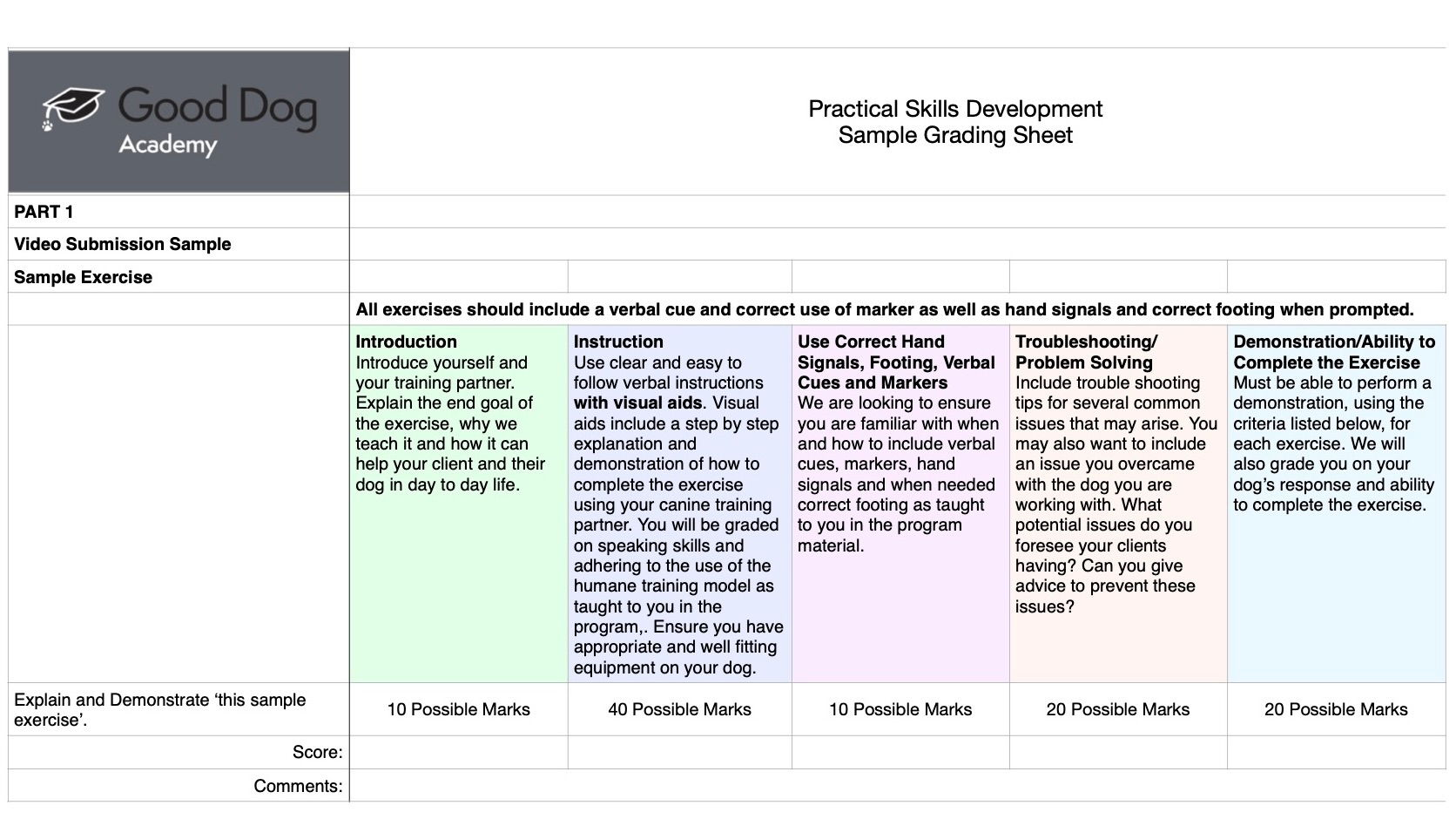
Each video submission is graded out of 100 points using the following criteria:
• Introduction — 10 points
Students should explain the purpose and end goal of the exercise, why the exercise is important, and how it can benefit the client and their dog.
• Instruction — 40 points
Students should provide clear, easy-to-follow verbal instruction along with step-by-step visual demonstrations using their dog. Students are graded on communication skills, professionalism, adherence to the Humane Training Model, and the use of appropriate and properly fitted equipment.
• Correct Hand Signals, Footing, Verbal Cues & Markers — 10 points
Students are evaluated on timing, mechanics, body positioning, handling skills, and clarity of communication throughout the exercise.
• Troubleshooting & Problem Solving — 20 points
Students should discuss common challenges that may arise, potential issues clients may encounter, and strategies to prevent or resolve these difficulties. Students may also discuss challenges they experienced with their own dog and how they addressed them.
• Demonstration & Ability to Complete the Exercise — 20 points
Students must successfully demonstrate the exercise according to the required criteria. Grading also considers the dog’s understanding, response, and ability to complete the exercise appropriately.
Students are evaluated on their ability to communicate professionally, demonstrate humane training techniques, explain exercises clearly, and successfully complete the required skills with their dog. Extensive feedback is provided throughout the process, and students may be asked to redo submissions if grading requirements are not met.
Students should refer to the “Master Guide to Submissions” section of this Handbook for complete recording and submission instructions.
Part 2 – Case Study Mastery
In Part 2, students complete three separate case study assignments based on realistic client, dog, and behaviour scenarios. Each case study includes background information about the dog, the guardian, and the behavioural concerns being presented.
Using knowledge gained throughout the Theory portion of the program, students are required to assess each case and develop an appropriate behaviour modification and training plan tailored to the needs of the dog and guardian. Students are encouraged to carefully review relevant Theory material before beginning these assignments.
A complete example is provided to help guide expectations and assignment structure.
A passing grade of 80% is required for each case study assignment. Students receive detailed feedback and may be asked to revise and resubmit their work if necessary. Reminder to submit only one assignment per week.
Part 3 – Empowering Client Support
In the final section of Practical Skills Development, students are provided with information about a client experiencing challenges with their dog. Students are required to create a professional client tip sheet explaining the dog’s natural behavioural and welfare needs, along with practical ways those needs can be appropriately fulfilled based on the information provided.
This assignment is designed to help students strengthen their ability to communicate clearly, professionally, and compassionately with clients while applying humane, evidence-based training principles.
A passing grade of 80% is required for this assignment. Students receive detailed feedback and may be asked to revise and resubmit their work if necessary.
Here is a sample grading sheet:
Graduation
Once students have successfully completed all Theory quizzes and the Final Exam, Dogsafe® Canine First Aid, and all three sections of Practical Skills Development, they will have completed the requirements for graduation from the PDT Program.
Good Dog Academy will review the student’s record to confirm that all program requirements and financial obligations have been successfully completed before issuing graduation materials.
Graduates will then receive a PDT Graduate package. Your graduation package includes:
-
A one-year extension of read-only program access
-
A Professional Dog Trainer Certificate
-
A graduate badge for use on websites and professional materials
Graduation from the PDT Program represents a significant professional and personal accomplishment, reflecting the time, dedication, practical experience, and knowledge gained throughout the program.
Canadian Standards Program (CSP)
Canadian Standards Program (CSP) Overview
The Canadian Standards Program (CSP) has been thoughtfully developed to align with the emerging national educational and professional standards being shaped by the Canadian Association of Professional Dog Trainers (CAPDT).
Designed for aspiring and established trainers seeking advanced professional development, the CSP focuses on comprehensive theory, evidence-based practice, ethics, critical thinking, and real-world application. The program is intended to help students strengthen their professional knowledge and practical understanding while preparing for the future Canadian National Certification Exam and the evolving landscape of professional dog training standards in Canada.
The CSP Program is designed to help students prepare for future national certification opportunities; however, completion of the program does not guarantee a passing grade on any future national examination. Student success depends on active participation, study, review, and application of the material presented throughout the program.
Some content within the CSP Program may feel familiar to graduates of Good Dog Academy’s Professional Dog Trainer (PDT) Program. This overlap is intentional, as the CSP expands upon foundational concepts while exploring them at a deeper and more advanced professional level.
Advanced Theory & Professional Standards
The Theory portion of the CSP Program focuses on advanced behaviour, assessment, ethics, coaching, case analysis, welfare, professional standards, and evidence-based training practices. Content is presented through written lessons, educational resources, examples, and guided learning activities intended to encourage deeper professional understanding and critical thinking.
Students are strongly encouraged to take notes, participate in lesson discussions, and review supporting materials carefully throughout the program. Helpful PDFs, examples, and additional educational resources are included throughout various sections.
Some sections may include quizzes, reflections, or written exercises designed to help students strengthen their understanding of the material and apply concepts to real-world scenarios. Students are encouraged to ask questions and actively participate in discussions throughout the program.
10 Theory Modules are completed in sequence to support progressive learning and skill development. Once sections have been unlocked, students may move freely between previously opened materials for review and study purposes.
Practicum Assessments
To successfully complete the CSP practicum requirements, students must achieve the minimum passing grade of 80% for each individual practicum component. All practicum components must be successfully completed in order to graduate from the program.
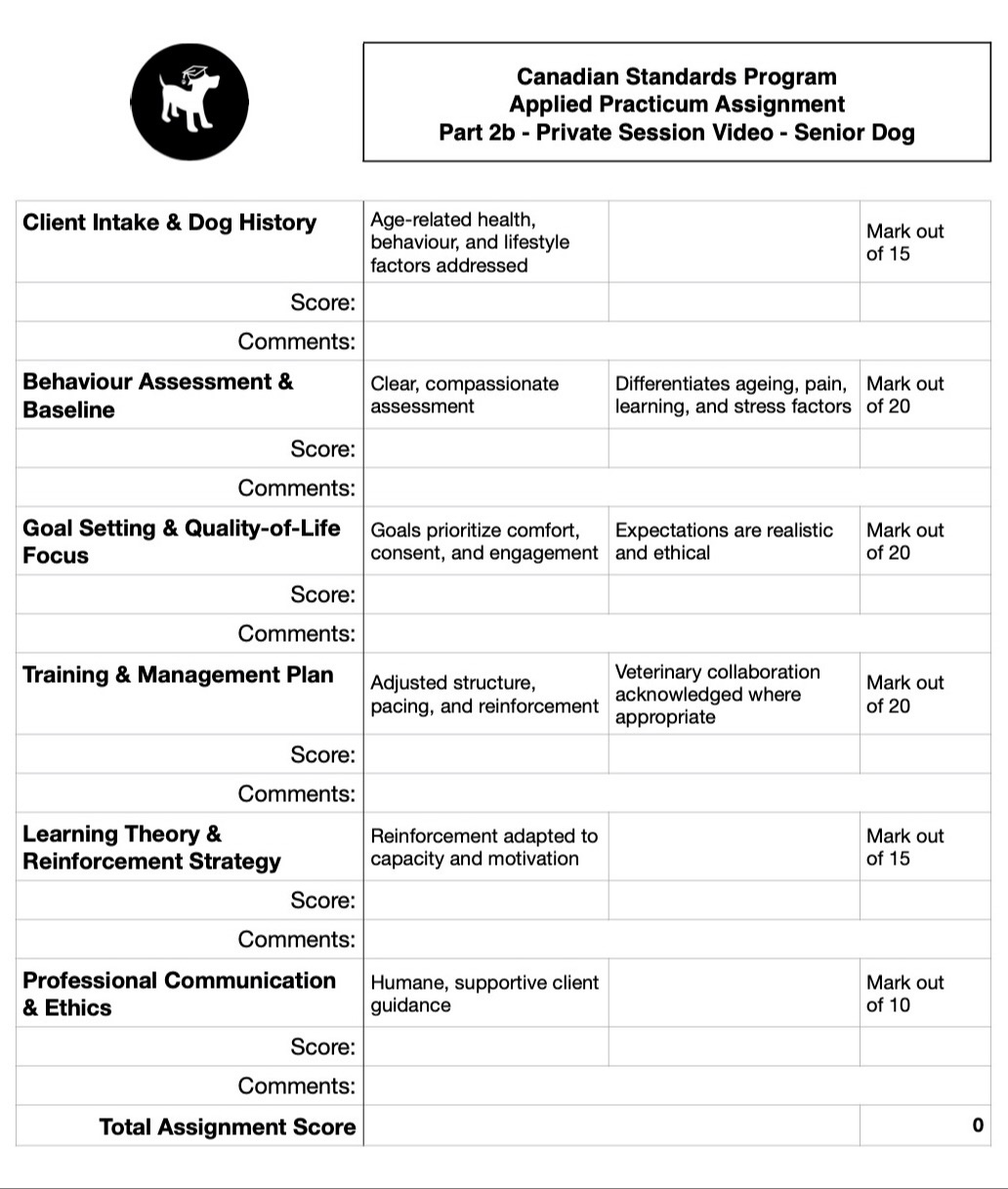
The CSP practicum consists of three separate assessments:
-
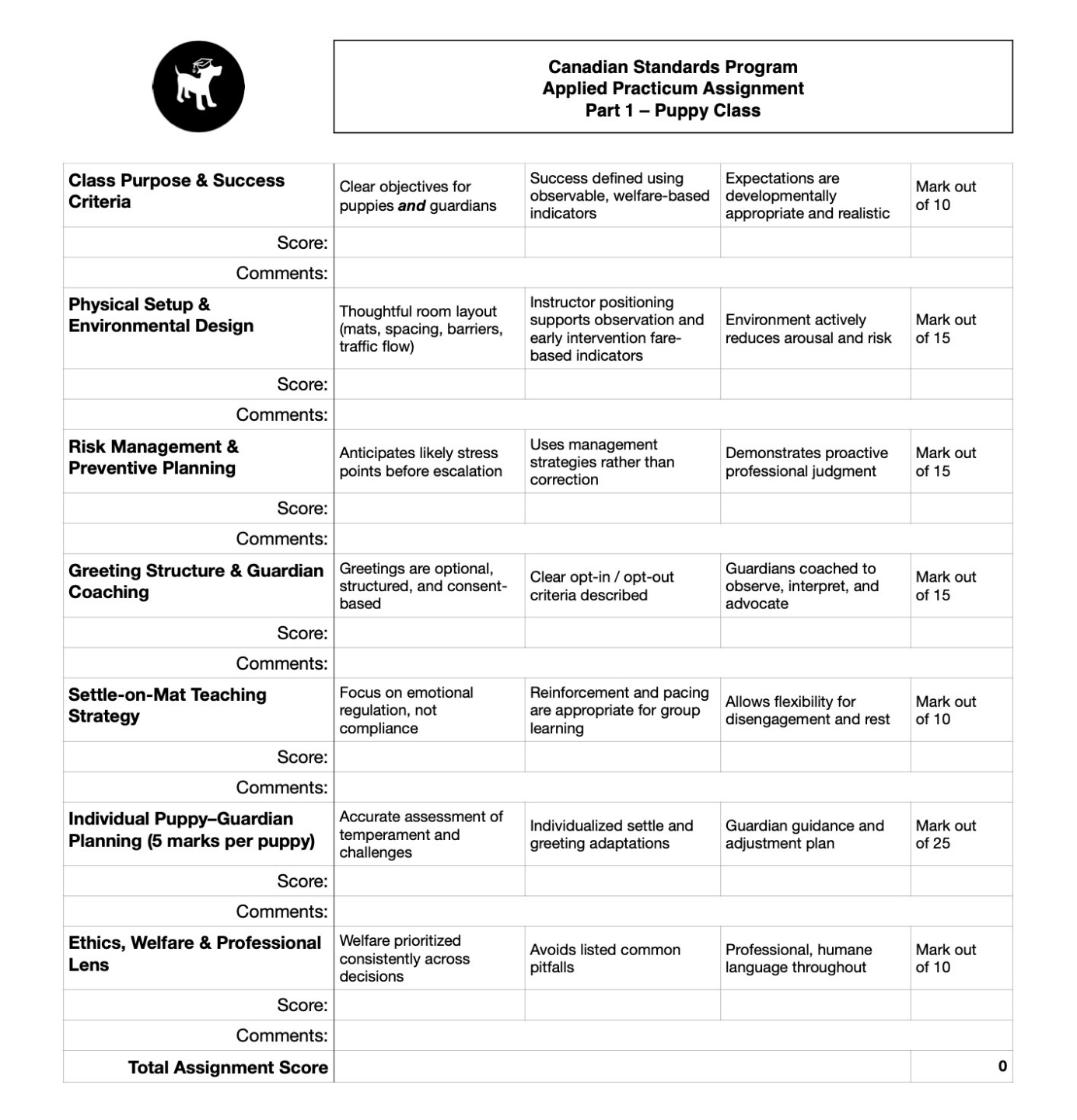
Part 1 – Applied Practicum Assignment: Puppy Class (Written Assignment)
-
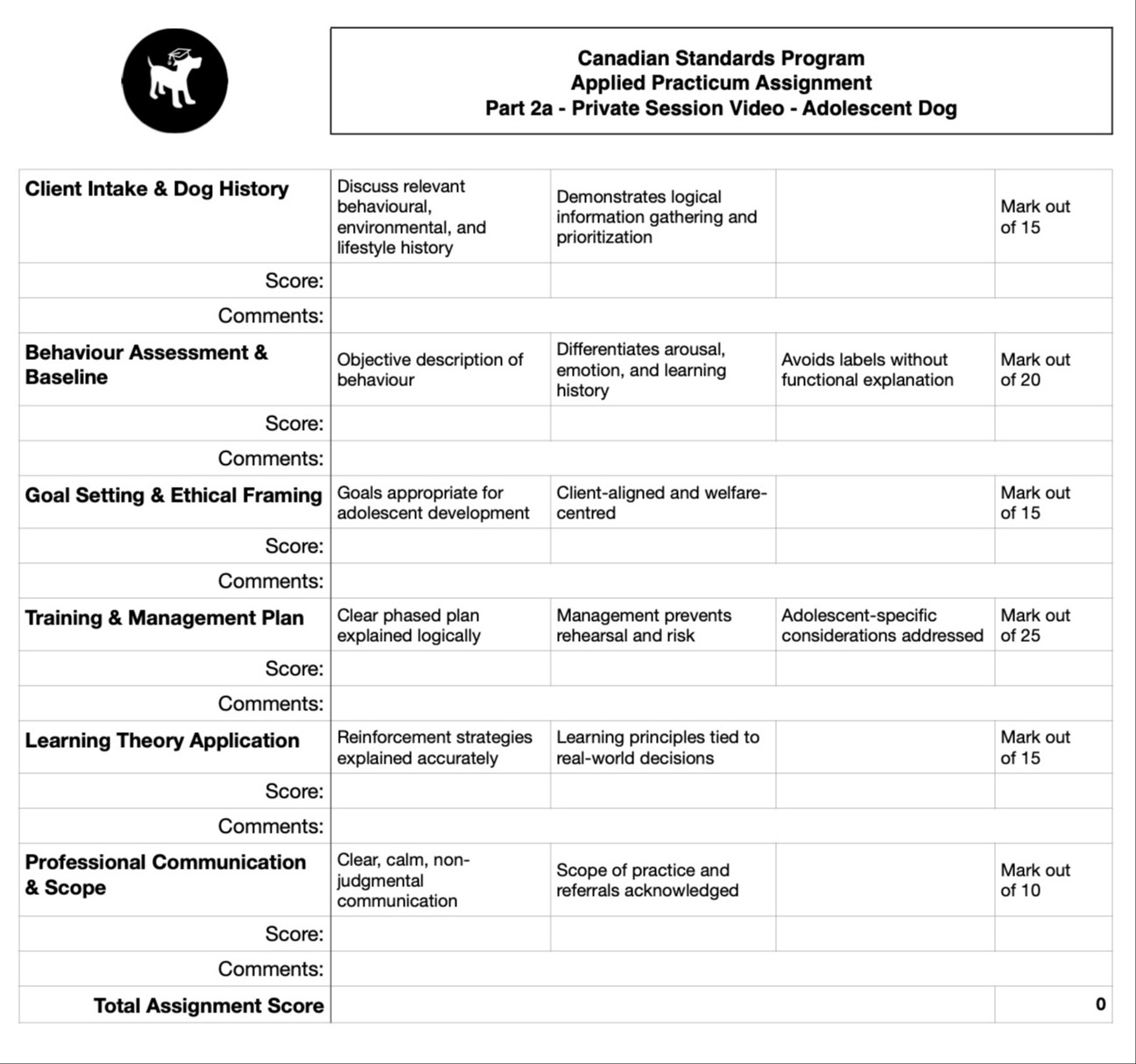
Part 2a – Private Session Video: Adolescent Dog
-
Part 2b – Private Session Video: Senior Dog
The practicum process is designed to evaluate professional readiness, critical thinking, ethical decision-making, and the student’s ability to apply humane, evidence-based training principles in realistic situations.
Practicum grading focuses on the student’s ability to demonstrate:
-
Welfare-centred decision-making
-
Ethical and appropriate application of training and behaviour principles
-
Awareness of safety, prevention, and risk managementAdaptability to the individual dog, guardian, and environment
-
Clear, professional communication and coaching skills
-
Thoughtful reasoning behind training choices and recommendations
The emphasis of grading is placed on how students assess situations, make decisions, and apply professional judgment rather than on achieving perfect training outcomes.
Practicum assessments are not graded based on:
-
Perfection of training results or behaviour outcomes
-
Performance style or charisma
-
Mechanical precision beyond safe and humane handling
-
Video production quality beyond basic visibility and audibility
For the written Puppy Class practicum assignment, a passing grade indicates that the student is demonstrating consistent graduate-level professional judgment appropriate for professional practice.
For the practical video assessments, a passing grade indicates that the student is demonstrating safe, ethical, and professionally appropriate application of humane training principles within real-world contexts.
Grades below the required passing threshold indicate that additional development and refinement are needed before the practicum component can be successfully completed.
Here are the grading sheets for your Practicum work:
Graduation
Once students have successfully completed all required CSP coursework, assignments, practical submissions, and financial obligations, Good Dog Academy will review the student’s profile to confirm that all program requirements have been met. This may take a few days.
Graduates will then receive either a CSP Graduate or CSP Honours Graduate package, depending on their final standing within the program.
Graduation packages include:
-
A one-year extension of program access
-
A Canadian Standards Program Certificate
-
A graduate badge for use on websites and professional materials
Graduation from the CSP Program represents advanced professional development and a commitment to continued growth, ethical practice, and higher-level standards within the dog training industry.
Graduates are eligible to apply to the Canadian Association of Professional Dog Trainers to write the Registered Dog Trainer™️ National Exam.
Continuing Education Opportunities
Continuing Education Options:
-
Train Your Dog - perfect as an add-on for your clients
Good Dog Academy is proud to be a progressive company that is always curious about new research and development in the dog industry. If you have topics or are a subject matter expert in an area not covered, please share your ideas with us!
We have multiple courses under development at this time.